How Much Should You Invest in SIP Every Month
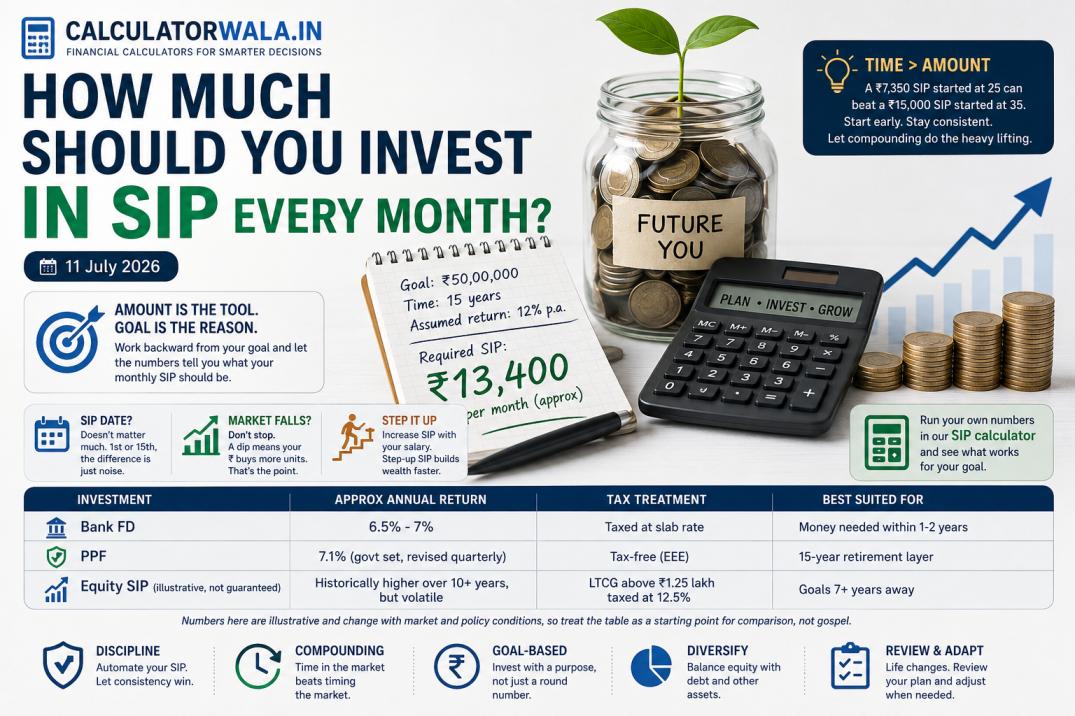
Everyone asks this like there's a magic number sitting in a vault somewhere. There isn't. I've had this exact conversation with at least a dozen friends over the years, usually after their first appraisal letter, and it always starts the same way: "just tell me how much to invest in SIP every month." The honest answer is that it depends on your expenses, your goals, and how much of your salary you can actually part with without living on Swiggy guilt for the rest of the month. But there is a better way to think about it than picking ₹5,000 because it sounds like a serious number. Run your own numbers in our SIP calculator and you'll see why the amount matters less than people think, and the duration matters more.
The problem with round numbers
Most people start a SIP at ₹2,000 or ₹5,000 or ₹10,000 because those are the buttons the app shows you first. Nobody sits down and asks "what do I actually need this money to become in 15 years." That's backwards. You're not investing an amount, you're funding a future number, and the amount is just the tool to get there.
Say you want ₹50 lakh in 15 years for a house down payment or your kid's education, whichever comes first in your life plan. Assuming a long-term equity mutual fund return (and I want to be clear, this is an assumption, not a promise SEBI or anyone else will hold you to), you'd need to invest somewhere around ₹13,400 a month. Not ₹10,000. Not ₹15,000. ₹13,400, or thereabouts once you account for compounding. That's the kind of specific, slightly annoying number that a goal-based calculation spits out, and it's more useful than any round figure you'd have picked on your own.
I'll admit I did this wrong myself for the first three years of my career. Started a ₹3,000 SIP because a colleague told me that's what he was doing. Never once checked what ₹3,000 a month for 30 years would actually become versus what I needed for retirement. Turns out it wasn't close. Lesson learned the expensive way, which is usually how these lessons land.
How much to invest in SIP based on your goal
Here's the thing nobody tells you when you're 24 and just started earning. The amount you invest matters far less over a 20-year horizon than when you start. A ₹7,350 SIP started at 25 will, in most historical scenarios, beat a ₹15,000 SIP started at 35, purely because of the extra decade of compounding. Time in the market does more heavy lifting than the size of your monthly contribution, and almost nobody internalises this until it's too late to get those early years back.
So work backward. Decide the goal amount and the year you need it. Plug it into our SIP calculator and let it tell you the monthly figure. If that number feels impossible right now, that's useful information too. Either the timeline needs to stretch, or the goal needs a haircut, or you need to find another ₹2,000 somewhere in your budget. Better to know that at 26 than discover it at 45.
SIP investment planning that actually survives a bad year
Markets will fall. Not might, will. Anyone who's watched their portfolio in March 2020 or through any of the corrections since knows the feeling of checking the app and immediately regretting it. This is where most SIPs die, not because the strategy failed but because the investor panicked and stopped.
And look, everyone insists you should start your SIP on the 1st of the month because that's when salary hits the account. Honestly, it doesn't matter. I've run the numbers across different SIP dates over long periods and the difference between a 1st-of-month SIP and a 15th-of-month SIP is noise. Rupee cost averaging works over years, not days. Pick whatever date your salary clears and move on with your life.
What actually matters is not stopping when things get ugly. A SIP that gets paused during a downturn is the single worst thing you can do to it, because you miss buying units at the exact prices that make the whole averaging strategy work. If anything, a market dip is when your SIP is quietly buying more units for the same ₹7,350, which is the entire point.
Step it up when your salary does
Nobody's SIP should stay flat for a decade while their salary triples. If you get a 10% hike this year, bump the SIP by at least that much next cycle, ideally more since your expenses probably didn't grow 10%. Our step-up SIP calculator shows how dramatically this changes your end corpus. A flat ₹10,000 SIP for 20 years builds a very different number than one that grows 10% annually alongside your career.
There's a tax angle too, worth mentioning briefly. If you're still on the old regime and using ELSS funds for your Section 80C deduction, remember the three-year lock-in applies per instalment, not per fund. Each SIP tranche has its own three-year clock. People assume the whole investment becomes withdrawable together and get surprised when it doesn't.
The FD-only mindset is quietly costing people money
RBI trimmed the repo rate through 2025, and bank FD rates followed it down, sitting somewhere between 6.5% and 7% at most public sector banks by the second half of the year. Meanwhile inflation, even at a moderate 5%, is eating a big chunk of that return before you've even paid tax on the interest. FD interest is taxed at your slab rate, no indexation benefit, nothing. For someone in the 30% bracket, a 7% FD is really closer to a 4.9% post-tax return, which barely beats inflation some years and loses to it in others.
None of this means FDs are useless. They're the right tool for money you need in the next one to two years, an emergency fund, a wedding fund, whatever has a fixed near-term date attached. But I still meet people well into their 30s and 40s with their entire net worth sitting in FDs and recurring deposits because that's what their parents did, and their parents weren't wrong for their era, rates were double digits back then. It's just a different world now. If you want to see where an FD-heavy portfolio actually lands, run the numbers in our FD calculator and compare it against the SIP figures above.
| Investment | Approx Annual Return | Tax Treatment | Best Suited For |
|---|---|---|---|
| Bank FD | 6.5%-7% | Taxed at slab rate | Money needed within 1-2 years |
| PPF | 7.1% (govt set, revised quarterly) | Tax-free (EEE) | 15-year retirement layer |
| Equity SIP (illustrative, not guaranteed) | Historically higher over 10+ years, but volatile | LTCG above ₹1.25 lakh taxed at 12.5% | Goals 7+ years away |
Numbers here are illustrative and change with market and policy conditions, so treat the table as a starting point for comparison, not gospel. If PPF's 15-year tax-free structure sounds like it fits your retirement layer, our PPF calculator will show you what disciplined yearly deposits actually build.
FAQ
Is ₹5,000 a month enough for a SIP? Enough for what, really. ₹5,000 for 20 years at a reasonably assumed long-term equity return could grow into a meaningful corpus, but "enough" depends entirely on your goal amount and timeline. Use a goal-based calculator instead of asking if a round number is sufficient.
Should I stop my SIP when the market falls? No, and this is probably the most expensive mistake retail investors make in India. A falling market means your fixed SIP amount buys more units. Stopping defeats the entire purpose of rupee cost averaging.
What's the difference between SIP and lumpsum investing? SIP spreads your investment monthly and averages out volatility, lumpsum puts everything in at once and depends heavily on timing. If you already have a large sum sitting idle, splitting it across both isn't unreasonable.
Does the date I run my SIP each month actually matter? Barely. The 1st versus the 15th versus the 25th makes almost no measurable difference over a long horizon. Pick a date after your salary clears and don't overthink it.
Can I increase my SIP amount later? Yes, most fund houses let you modify the SIP amount or set up a step-up SIP from the start that automatically increases it annually by a percentage you choose.
This is educational information based on standard assumptions, not investment advice, and mutual fund returns are subject to market risk.
Run the numbers
Free calculators for what this article covers.
Keep reading
- PPF vs SIP Where Should Your Money Actually GoPPF vs SIP, a real comparison of safety versus growth with actual numbers, so you can decide where your money should go instead of picking on gut feel.
- Education Loan Interest Rates 2026: SBI vs HDFC vs ICICI vs Axis ComparedCompare education loan interest rates across SBI, HDFC, ICICI and Axis Bank — see how a 1.5% difference can cost you ₹88,000 extra in interest.
- Section 80E: How Much Tax Can You Actually Save on an Education Loan?Claim 100% of your education loan interest under Section 80E no upper limit. See who qualifies, how much you can save, and the old-regime catch people miss.