The IRA Pro-Rata Rule Explained (With a Real Example)
Someone I know did everything right on paper: contributed $7,500 to a Traditional IRA, converted it to a Roth within a week, filed the paperwork. Then their tax bill showed most of that conversion as taxable income anyway. Nothing about the contribution or conversion was done wrong — the problem was an old 401(k) rollover IRA from a job they'd left years earlier, sitting untouched in the background. That's the IRA pro-rata rule, and it's the single most common way a backdoor Roth conversion goes sideways.
What Is the Pro-Rata Rule?
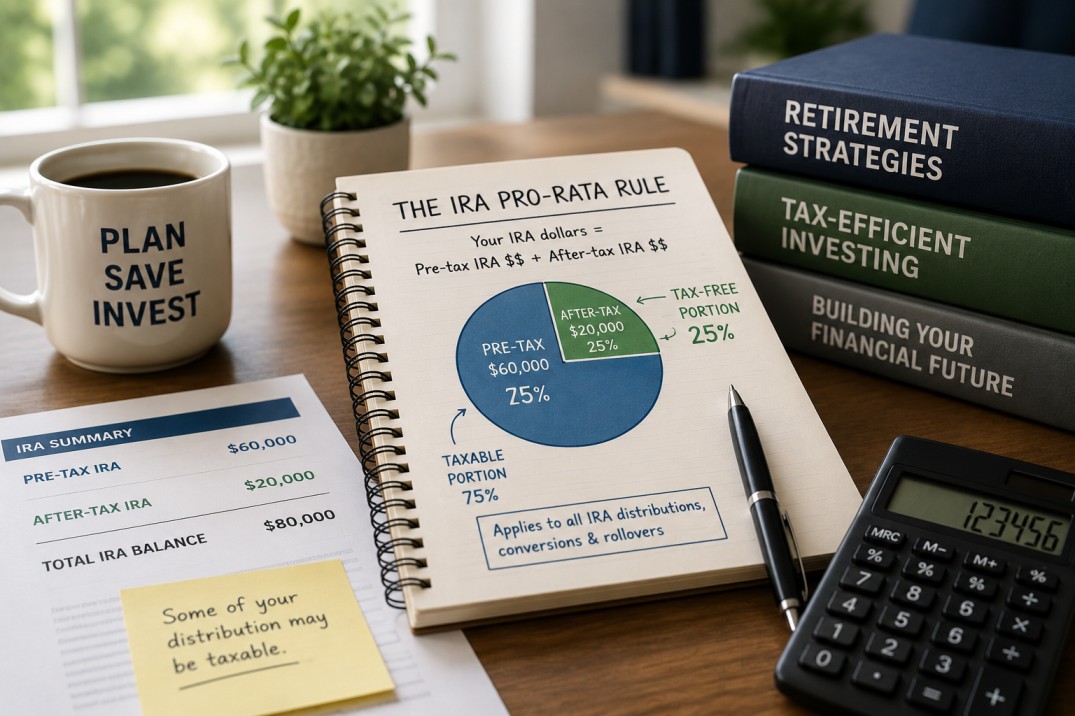
The IRS doesn't let you treat your IRA contributions as separate buckets, even if you think of them that way. Every Traditional, SEP, and SIMPLE IRA you own gets aggregated into one combined balance for tax purposes. When you convert any part of that combined balance to a Roth IRA, the IRS taxes the conversion in the same proportion as your whole pool: partly already-taxed basis, partly pre-tax money that's never been taxed.
You can't choose to "convert only the new, already-taxed money." The IRS pro-rata rule decides that ratio for you, based on everything you're holding across every Traditional-style IRA you have, on December 31 of the conversion year.
Why It Trips Up Backdoor Roth Conversions
The backdoor Roth strategy assumes a clean slate: contribute $7,500 nondeductible, convert it immediately, pay tax on close to nothing since there's no pre-tax money mixed in. That assumption only holds if you have zero other pre-tax Traditional, SEP, or SIMPLE IRA balances. The moment you're holding an old rollover IRA from a previous 401(k), the pro-rata rule pools it with your new contribution and taxes the conversion proportionally.
Here's what that looks like on an identical $7,500 contribution and conversion, at different old-IRA balances:
| Old Pre-Tax IRA Balance | Share of Conversion Taxed | Tax Owed (24% bracket) |
|---|---|---|
| $0 (clean backdoor) | 0% | $0 |
| $10,000 | 57% | $1,029 |
| $25,000 | 77% | $1,385 |
| $50,000 | 87% | $1,565 |
The contribution and conversion amount never changed. Only the old balance sitting in the background did — and it's what decides how much of your "tax-free" backdoor Roth actually ends up taxed. Run your own numbers through our Backdoor Roth IRA Calculator to see your exact taxable share before you convert, not after.
What Counts Toward the Pro-Rata Calculation (and What Doesn't)
- Counts: Traditional IRAs, SEP IRAs, SIMPLE IRAs — including old 401(k) or 403(b) balances you've rolled into an IRA at any point.
- Doesn't count: Roth IRAs (obviously — they're already after-tax), and money still sitting inside an employer plan like a 401(k), 403(b), or 457(b) that you haven't rolled into an IRA.
That second point is the whole workaround. If your old pre-tax money is still inside an employer plan rather than an IRA, it's invisible to the pro-rata calculation.
How to Avoid the Pro-Rata Trap
- Roll old pre-tax IRA balances into your current employer's 401(k) first, if the plan accepts incoming rollovers (most do). Once that pre-tax money is inside the 401(k) instead of an IRA, your IRA balance is clean, and your backdoor Roth conversion goes back to being close to tax-free.
- Convert in the same year you contribute, and don't let the money sit. Any investment growth between contribution and conversion becomes taxable income, pro-rata rule or not — it's a small amount for most people, but it's not zero.
- Check your balance on December 31, not the day you convert. The IRS looks at your combined Traditional-style IRA balance at year-end, so a rollover completed anytime before December 31 of the conversion year still counts.
For the actual mechanics of contributing and converting, our backdoor Roth IRA step-by-step guide walks through the full process, including filing Form 8606, which is where you formally report your after-tax basis to the IRS.
FAQ
What is the pro-rata rule in simple terms? It's the IRS rule that treats all your Traditional, SEP, and SIMPLE IRA money as one combined pool when you convert any of it to a Roth IRA, taxing the conversion in proportion to how much of that pool is pre-tax versus already-taxed.
Does the pro-rata rule apply to my 401(k)? No — only to Traditional, SEP, and SIMPLE IRAs. Money sitting inside an employer 401(k), 403(b), or 457(b) plan is excluded from the calculation entirely, which is exactly why rolling old IRA balances into a 401(k) is the standard way to clear the pro-rata trap.
How do I avoid the pro-rata rule on a backdoor Roth? Roll any pre-tax Traditional, SEP, or SIMPLE IRA balances into an employer 401(k) before December 31 of the year you convert, so your IRA balance is effectively zero pre-tax money at the time the IRS checks it.
Is Form 8606 related to the pro-rata rule? Yes — Form 8606 is where you report your nondeductible IRA contributions and calculate the taxable portion of a conversion. It's the form that actually applies the pro-rata math to your specific numbers when you file.
This is educational information, not tax advice — the pro-rata calculation depends on account balances the IRS defines precisely, and getting it wrong on your return can be costly, so verify your specific numbers with a tax professional. For the source rules, see the IRS's guidance on IRA rollovers and conversions.
Run the numbers
Free calculators for what this article covers.
Keep reading
- Mega Backdoor Roth 401(k): The Complete Step-by-Step Guide (2026)How the mega backdoor Roth 401(k) works in 2026, the after-tax contribution limits, whether your plan even allows it, and how it's different from a regular backdoor Roth IRA.
- Roth vs Traditional 401(k)/IRA: Which Should You Actually Choose? (2026)A concrete framework for choosing Roth vs Traditional 401(k) or IRA in 2026, based on your actual tax brackets, not vague 'it depends' advice — plus when to split contributions between both.
- The Real Cost of the NEET 2026 Paper Leak to Affected StudentsNEET UG 2026 was cancelled after a paper leak and the retest fee was waived, but that's not the whole cost. Here's what the 7-week delay actually cost families.