Backdoor Roth IRA: Step-by-Step Guide (2026)
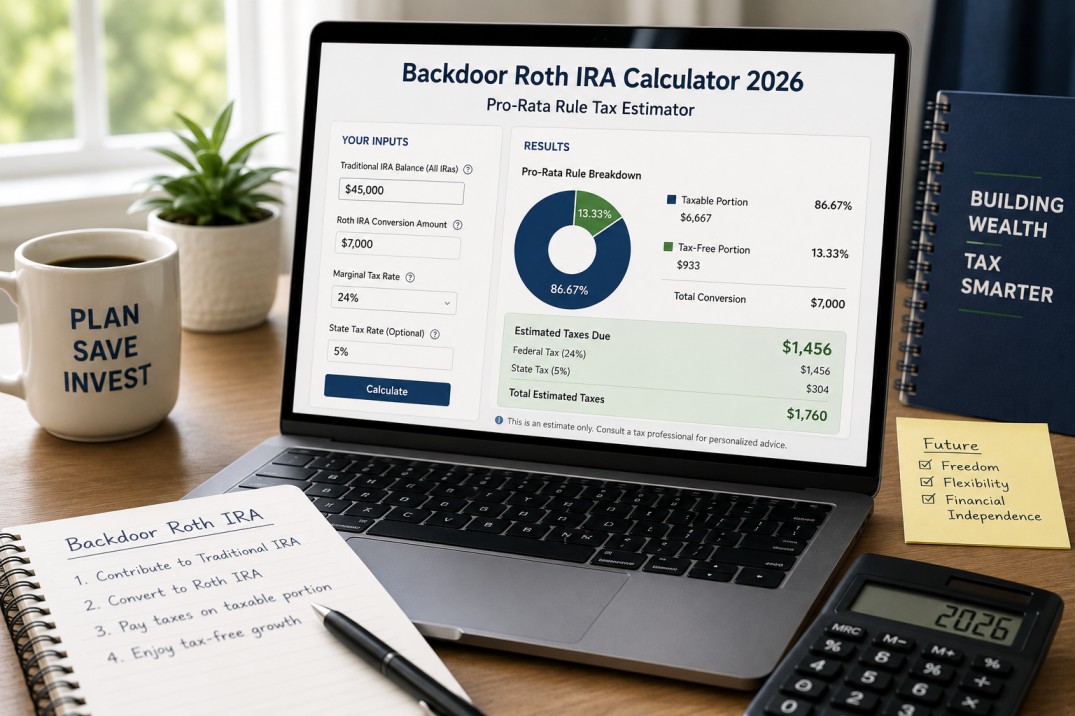
If your income is high enough, the IRS simply won't let you contribute to a Roth IRA directly. No exceptions, no phone call to make, the door is just closed above a certain MAGI. The backdoor Roth IRA is the legal workaround nearly every high earner ends up using instead, and once you've done it once, it's a five-minute process each year. The part that trips people up isn't the mechanics, it's a tax rule almost nobody mentions until after they've already made the mistake.
Why You Need a Backdoor Roth IRA
Direct Roth IRA contributions phase out completely above these 2026 income limits:
| Filing Status | Contribution Starts Reducing | Fully Phased Out |
|---|---|---|
| Single / Head of Household | $153,000 | $168,000 |
| Married Filing Jointly | $242,000 | $252,000 |
| Married Filing Separately | $0 | $10,000 |
Cross the top of that range and you can't put a single dollar directly into a Roth IRA that year, no matter how much you want to. But there's no income limit at all on nondeductible contributions to a Traditional IRA, and no income limit on converting a Traditional IRA to a Roth IRA either. String those two facts together and you get the backdoor Roth: contribute where there's no limit, then convert.
How to Do a Backdoor Roth IRA (Step by Step)
- Contribute to a Traditional IRA. For 2026 the limit is $7,500 ($8,600 if you're 50 or older), and you make this as a nondeductible contribution, meaning you don't claim a tax deduction for it. This matters for step 3.
- Convert the Traditional IRA to a Roth IRA. Most brokerages let you do this online in a few clicks. Convert soon after contributing, ideally before the money has time to earn meaningful gains, since any growth between contribution and conversion is taxable.
- Report both moves on Form 8606. This is the step people skip and regret. Without it, the IRS has no record that your contribution was already after-tax, and you risk being taxed on the same money twice.
- Pay tax on any gains, and check the pro-rata rule first. If your only IRA balance was the contribution you just made, the taxable amount is small or zero. If you're holding other pre-tax IRA money, read the next section before you convert, not after.
The Pro-Rata Rule (the Part Most Guides Skip)
Here's the trap: if you already hold other Traditional, SEP, or SIMPLE IRA money from an old 401(k) rollover or years of deductible contributions, the IRS doesn't let you cherry-pick which dollars you're converting. It treats all your Traditional IRA balances as one pool, and taxes your conversion proportionally, based on how much of that combined pool is already-taxed basis versus untaxed pre-tax money. This is the pro-rata rule, and it's the single most common way a "tax-free" backdoor Roth conversion turns into a partially taxable one.
Concretely: if you have $42,500 sitting in an old rollover IRA and you contribute $7,500 nondeductible and convert it, you don't get to say "I'm only converting my new $7,500." The IRS looks at your $50,000 combined balance, sees that only 15% of it is after-tax basis, and taxes 85% of your conversion accordingly, even though the money you meant to convert was entirely after-tax.
Run your own numbers through our Backdoor Roth IRA Calculator before you convert. It applies the pro-rata formula directly and shows you exactly what portion of your conversion the IRS will actually tax, including what changes if you roll old pre-tax balances into a 401(k) first to clear the pro-rata trap entirely. For the full mechanics of how this rule works and how to avoid it, see our complete guide to the IRA pro-rata rule.
Filling Out Form 8606
Form 8606 is how you tell the IRS "this money was already taxed, don't tax it again." You file it for the year you make the nondeductible contribution, and again for the year you convert, if those happen to be different tax years. Miss it, and there's no paper trail showing your contribution basis, which means the IRS defaults to assuming the whole conversion is taxable. The IRS's official Form 8606 page has the current form and instructions; most tax software (TurboTax, FreeTaxUSA, and others) will generate it automatically if you answer the nondeductible-contribution and conversion questions correctly, but it's worth checking that it actually shows up in your final return.
Backdoor Roth IRA Rules & Limits (2026)
- Contribution limit: $7,500 per year ($8,600 if you're 50+), same as the regular IRA limit — the backdoor route doesn't let you contribute more, just get around the income cap.
- No income limit on the contribution or conversion steps themselves — the income limit only blocks direct Roth contributions, not the nondeductible-contribution-then-convert combination.
- No annual limit on how many times you can do this — it's a repeatable strategy, not a one-time loophole, and most people who use it once do it every year going forward.
- The five-year rule still applies to converted amounts if you might need to withdraw before age 59½, so this isn't a substitute for an emergency fund.
FAQ
Is a backdoor Roth IRA legal? Yes. It's a long-standing, IRS-acknowledged strategy built from two individually legal moves — a nondeductible Traditional IRA contribution and a Roth conversion — neither of which has an income restriction on its own.
Do I have to pay taxes on a backdoor Roth IRA? Only on the portion that represents pre-tax money or investment growth. If you convert quickly and have no other Traditional IRA balances, the taxable amount is usually close to zero. If you do have other pre-tax IRA balances, the pro-rata rule applies — see above.
What is the pro-rata rule? The IRS rule that treats all your Traditional, SEP, and SIMPLE IRA balances as one combined pool when you convert, taxing your conversion proportionally to how much of that pool is pre-tax versus already-taxed. It's why a "clean" backdoor Roth requires having no other pre-tax IRA money lying around.
Can I do a backdoor Roth IRA every year? Yes, there's no limit on repeating the strategy annually, and most people who set it up once keep doing it every year they're over the direct-contribution income limit.
This is educational information based on 2026 IRS figures, not tax advice — talk to a tax professional about your specific situation before converting, especially if you're holding other pre-tax IRA balances. For the current rules directly from the source, see the IRS's Traditional and Roth IRA guidance.
Run the numbers
Free calculators for what this article covers.
Keep reading
- The IRA Pro-Rata Rule Explained (With a Real Example)The IRA pro-rata rule explained with real numbers: why an old rollover IRA can make your backdoor Roth conversion mostly taxable, and how to avoid it.
- Mega Backdoor Roth 401(k): The Complete Step-by-Step Guide (2026)How the mega backdoor Roth 401(k) works in 2026, the after-tax contribution limits, whether your plan even allows it, and how it's different from a regular backdoor Roth IRA.
- BMI vs Body Fat Percentage: Which One Should You Actually Trust?BMI vs body fat percentage: why a simple height-and-weight formula can call a muscular, healthy person overweight, and when each number is actually useful.